Showing posts with label male suffrage. Show all posts

Tuesday, November 20, 2012

Daniel Howard: Democrat

For our purposes of increasing the circumstantial evidence of Jeremiah Phillips being a democrat, we add the evidence of Daniel Howard, a significantly important individual in Foster, Rhode Island.

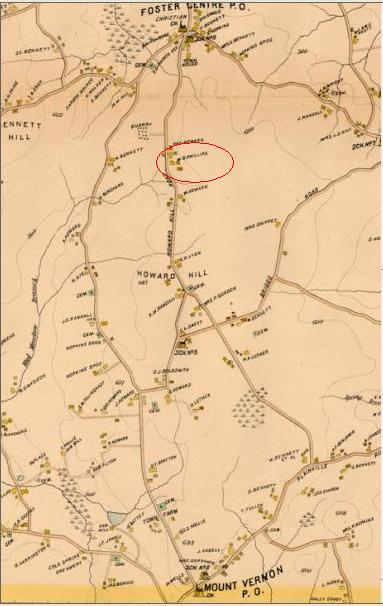
Foster Centre is a later name for the area believed to have been the general area within the township that the Philips family lived prior to 1848.  See map from circa 1890's, the only one currently available at this writing.

We now quote freely from: History of Isaac Howard of Foster, Rhode Island, and his descendants who have borne the name of Howard, bt Daniel Howard, privately printed at Windsor Locks, CT, 1901


HON. DANIEL HOWARD was born in Foster, R. I., March 15, 1787. His education was ol)tained in the common schools of his town, where he was especially fortunate in having as his instructor for one year Benjamin Dolton, a graduate of the University of Dublin, Ireland, a teacher famed for his learning, and especially for his penmanship, Under the training of this master he became the most expert penman in his town, and when in 1803 his father was elected town clerk of Foster he rendered much aid as assistant. His father died in September, 1827, and on the first day of October following he was elected to the vacant office of town clerk, which office he held continuously for twenty-five years. During this time he served thirteen terms as Representative in the State legislature, a term being at that time half a year. On his journey home from Providence at the close of each week, a distance of nearly twenty miles, which he usually made on foot, it was his custom to stop at the wayside inns, where the people would be gathered to hear from him what had been the business of the week.

In 1834 he became one of the judges of the Court of Common Pleas, serving nine years between that time and 1848, being the choice of his party whenever it was successful at the polls. He was off the bench in 1835 and on again in 1836 and '37; off till 1842; then on again till 1848. From 1844 to '48 he sat as associate with the judge of the Supreme Court.

In politics he was a Democrat. During the Dorr troubles of 1842 he favored the extension of the suffrage, but could not countenance the course pursued by the Dorrites to accomplish it. Hence he allied himself with the Law and Order men.

In local public affairs he was the most prominent man in Foster. He served fifteen years as justice of the peace; was assessor of taxes; was called upon to administer upon thirty-one estates; was a practical surveyor; was much in demand as a conveyancer and to draft wills and write all forms of legal papers for his townsmen and the citizens of adjoining towns; was much resorted to for legal advice, and, in short, was looked upon for half a century as a sort of legal umpire for his section of the state.

In 1811 he purchased his brother Gorton's interest in the farm which for seven years they had owned together, about two miles south of Foster Center, and on which they had already built a house and barn.

In 1856 Judge Howard built another and larger house, uniting it to the older one. These were his home from 1811 till his death, except that from 1838 to '41 he lived with his son Horace at Foster Center and again in 1843, after the death of Horace, he moved there to look after the interests of the estate, remaining till the spring of 1846, when he sold the property and returned to his farm.

On September 24, 1809, he married for his first wife Betsey Phillips (b. August 22, 1789), daughter of Asaph and Esther Phillips of Foster. She died December 16, 1849.

For his second wife he married, April 21, 1851, Lurana Howard (b. March 11, 1815), widow of his nephew, William Howard, and daughter of Saiimel and Elizabeth (Whipple) Wilbur of Seituate, R. I. He died July 15, 1879. His widow now lives with his grandson, Pardon T. Howard.

He had one son by his first wife: Horace, born Jan. 31, 1810.

That Howard was critically influential is an historic fact.  There is some interest that Howard Phillips Lovecraft derived his first name from this local legend.  This despite that Whipple Van Buren Phillips was a life long Republican.  We do not know when he converted, but as James Wheaton Phillips was also a life long Republican, it was possibly after their father's death.  Alternatively, the split may well have occurred at the Dorr Rebellion convention as some "Democrats" were more radical, and Howard was a civilized "Law and Order" man.

We have one more piece of testimony, from Casey B. Tyler.  It parallels the same details with more genealogy.  (Here).  He reports Howard was a member of the East Greenwich, R.I. committee (1842) after the Dorr Rebellion (more on this in a future blog essay) to make the new constitution guaranteeing male suffrage.

Most notable, see that Judge Howard was married to Betsey Phillips (1789-1849) ** who was Jeremiah Phillips' older sister.

As pointed out elsewhere, Foster, Rhode Island can be considered a tribal community from an anthropological and sociological perspective.  They tended to associate by clans, and marriages were at least partially arranged through elders - at least approval was sought and given in many cases.  It was not unusual to have first cousin marriages in New England. Franklin and Eleanor Roosevelt are later examples of this.  These types of marriages tended to cement and secure social hierarchies and political connections.  The same types of marriages currently happen in the Middle east, the Near East, and in other third world and second world cultures.

This said, if Judge Howard was a Democrat, it is highly probable that Jeremiah was influenced by this great man to also be a Democrat..


**[dates courtesy of Ken Faig, Some of the Descendants of Asaph Phillips and Esther Phillips of Foster, Rhode Island. Mr. Faig may not have been aware at the time of the exact date of ]


Judge Daniel Howard's (the younger) Obituary


1850 Census with James Wheaton Phillips listed as head of family


Thursday, November 15, 2012

5 August 1833: Martin Van Buren on R. I. Suffrage


I can't tell you how lucky I was to find this.  Pure serendipity.

A group of Providence merchants looking for authorities to discuss (and agree with) universal (Caucasian) male suffrage wrote to then-VP Van Buren.  Van Buren was well known for dodging a straight answer.  

He once told a story on himself that a man approached him and asked him if the sun rose in the east?  Van Buren replied that he did not rise so early as to notice.  A classic political dodge.

Yet here, he goes out of his way not only to speak of New York's track record of suffrage, but to do it as Vice President.

It would be almost impossible for Jeremiah Phillips to miss this.  I find it more circumstantial evidence that Jeremiah was a Van Buren man, a democrat.

_____


Washington Globe August 5, 1833

Monday,  5 August 1833

CORRESPONDENCE.

PROVIDENCE, May  31, 1833.

RESPECTED SIR:—At a meeting held in this city on the 19th ultimo, of persons favorable to the adoption in this State of the Massachusetts mode of Suffrage, the subscribers were appointed a prudential committee with an understanding that they should report their proceedings at subsequent meetings.

For many years, the proposed plan has been much on the minds of some of the Committee, but whenever proposed, some objection or other has always been interposed by the timid or the interested.

For four or five years past, the election of Jackson to the Presidency, has been urged by a majority of freeholders in this State, as an insurmountable objection against General Suffrage, from the well known fact that he was emphatically the choice of the democracy or common people, and from their real or
pretended fears that he would use his military prowess to subjugate the liberties of the people, and build a despotism on their ruins.

Notwithstanding the Committee is composed of individuals of all parties now existing in the State, yet they all agree that whatever differences of opinion may at present prevail on minor political questions, yet that the real or pretended fears alluded to, have been completely annihilated, and that those who formerly urged them, to defeat our enterprise, must acknowledge one of two things: either that the democracy of the country decided safely in choosing our present Chief Magistrate, or having decided unsafely — the strength and purity of our glorious republican Constitution is sufficient to regulate any temporary error which the system of General Suffrage may occasion

Soon after our appointment, our former opposers not having the effrontery to urge their exploded objection, must needs create new ones. The first was that "the Massachusetts mode of Suffrage, would ruin Rhode Island," and that "the best part of the citizens of that State, regret their extension of  Suffrage, and would willingly adopt the Rhode Island mode were it practicable for them to do so."

We immediately addressed letters to Hon. Francis Baylies, Hon. J.Q. Adams and Hon. Daniel Webster, to ascertain from such high authority if those things were so.

The answers of Messrs. Baylies and Adams, have been published pretty generally in the newspapers. From Mr. Webster, we have received no answer.

Having so completely proved this first new coinage of our opponents to be a counterfeit we were in hopes that the time had at least arrived, when our favorite project would be adopted, without further opposition; but our hopes were vain, for their mint has issued an other objection in this shape:

"If General Suffrage is allowed in this State, it will be the same as it is in New York, where vessel loads of foreigners land. and go immediately to the polls and vote away the rights and moneys of American born citizens."

Now if it would not infringe on your valuable time, nor the dignity of your high office, (both of which every American citizen has an equal interest in,) the subscribers would consider it as a great favor to receive from you answers to the following questions:

1st.  What are the laws in New York, concerning the Right of Suffrage.

2d.   Do you consider there is any evil arising either under the present law or practice in New York, so great as that one would be, of sacrificing the true Democratic principle of General Suffrage, to any notion of expediency arising from a fear that some are now allowed to vote who are incapable of exercising that high privilege?

And lastly.   Have you any doubts of the perfect safety of trusting to the virtue and intelligence of the aggregated voters of New York, under your present election laws, to manage the public concerns?

As these questions relate solelyto the affairs of the State of New York, we can see no impropriety in a distinguished native born citizen answering them, but if our humble opinions (on this last point) are. overruled by those who certainly have a better opportunity and a better right to judge, the only part we
can act is to submit without a murmur.

Very respectfully, your fellow citizens,
WILLIAM I. TILLINGHAST, Barber.
LAWRENCE RICHARDS, Blacksmith.
WILLIAM MITCHELL, Shoemaker.
SETH LUTHER, Housewright.
WILLIAM MILLER, Currier.
DAVID BROWN, Watch & Clock Maker

Hon. MARTIN VAN BUREN,
Vice President of the U. S.

[The Committee thought it necessary for Mr. Van Buren's information to state, that in R. Island, no citizens, however otherwise qualified to vote, unless such as own land;  and their eldest son; while in Massachusetts all citizens can vote who have resided in the State one year and the county six months, and have paid a poll tax.)

WASHINGTON, July 9th, 1833.

Gentlemen—I have the honor to acknowledge the receipt of your letter, requesting information concerning the manner in which the right of Suffrage is regulated in the State of New York, together with my opinion upon the utility and practical operation of the system now in force there.

I can have no objection whatever to furnish the information you desire, but I feel some delicacy, under the circumstances of the case in expressing an opinion on the several points to which you refer.   The right of suffrage not only controls the election of the State functionaries, but that of the elective officers of the General Government, is, by the Federal Constitution, made dependent on it; and in this respect, it is undoubtedly to be considered, not only as a matter of primary importance to those who are immediately interested in it, but as a subject of interest to all parts of the Union. The settlement of all
questions connected with this franchise in any particular State, has however usually been regarded belonging exclusively to the people of that State; and under ordinary circumstances any interference by a citizen of another State, would justly be considered as improper. Thus viewing the matter, I certainly should not have ventured an opinion upon any point bearing on the question now under discussion in Rhode Island, had it not been for the request contained in your letter, which the relations I hold to the people of the United States make it my duty to respect.

By the first Constitution of New York the possession of a freehold estate of the value of $250 over and above all debts charged thereon, was necessary to entitle a person to vote for Governor, Lieut. Governor and Senators  — Members of Assembly were chosen by persons paying taxes and possessing freeholds of the clear value of $50, or renting tenements of the annual value of five dollars.

The obvious injustice, and ascertained in-utility of this regulation, together with other  causes, led in 1821, to the call of a Convention for the revision of our State Constitution  — of that Convention I had the honor to be a member, and in the discharge of the duties imposed upon me by that situation I labored, and in conjunction with a majority of the Convention, labored successfully, to abolish the freehold qualification.   The principle which I then advocated and which was established by the amended Constitution, extended the right of voting for all elective officers of the State Government to every citizen who should contribute to the support of Government, either by the payment of taxes in money, or by labor on the highways, or by service, according to law, in the Militia. The results of experience and the progress of liberal opinions, soon led to a further extension; and by an amendment to the Constitution finally adopted in 1826, the right of suffrage was given to every male citizen of full age, who shall have been an inhabitant of the State for one year, and of the county for six months,
preceding the election. This provision however, does not extend to persons of color, who by the Constitution of 1821, are not allowed to vote, unless they have been for three years citizens of the State, and for one year before the election, seized and possessed of a free-hold of the clear value of $250, and have been rated and paid a tax thereon.

The Government of New York has for several years, been administered under the liberal system established by the new Constitution, and the still more liberal amendment of 1826, in a manner which appears to have been satisfactory to the people. It is possible, that there may be some who regret the extension of the right of suffrage, and who would be gratified by the revival of the old qualifications; but I do not believe that such a feeling entertained by any considerable portion of our citizens, I am very sure that any attempt to restrict the exercise of the right and more especially to restore the freehold qualification, would be put down by an overwhelming majority.

In acting upon this subject, my own course has never been influenced by any apprehension that it would be dangerous to the rights of property, to extend the right of voting to those who were without property. Our experience has, I think, fully demonstrated, that in a community like that which composes a great majority of every State in our confederacy, there is no reason for alarm in this respect.

At an earlier period of my public life, I was not entirely free from apprehensions of the influence of wealth upon so extended a suffrage as that which is now possessed in New York. Upon this head, however, we are now able to speak from full and satisfactory experience; and it has given me the highest gratification to be convinced, that my fears were without adequate foundation.—  Numerous opportunities to test the firmness of our citizens, and their ability to resist the seductions of wealth, have been furnished within the last twelve years; and although some local and temporary advantages may have been occasionally gained through such means, the general incorruptibility of our citizens has been triumphantly established.— Nor have I any doubt that such will long continue to be the history of our people; for although a greater disparity in their condition may naturally be expected from an increase of population and other causes, yet on the other hand it may be hoped that the means of education, and of moral improvement will be proportionally increased, and that under their influence the spirit of independence and of intelligent patriotism, which now prevails among all classes will be cherished and exhibited by every succeeding generation.

With my best wishes for your individual prosperity, and for that of the State to which you belong,

I remain, gentlemen, your obedient servant,

M. VAN BUREN.
To Messrs. William I. Tillinghast, Lawrence Richards, William Mitchell, Seth Luther, William Miller,
and David Brown.

Total Pageviews